
Sails Trim Simulator
The traveller, the sheets, the cars and the telltales — what each line does, step by step
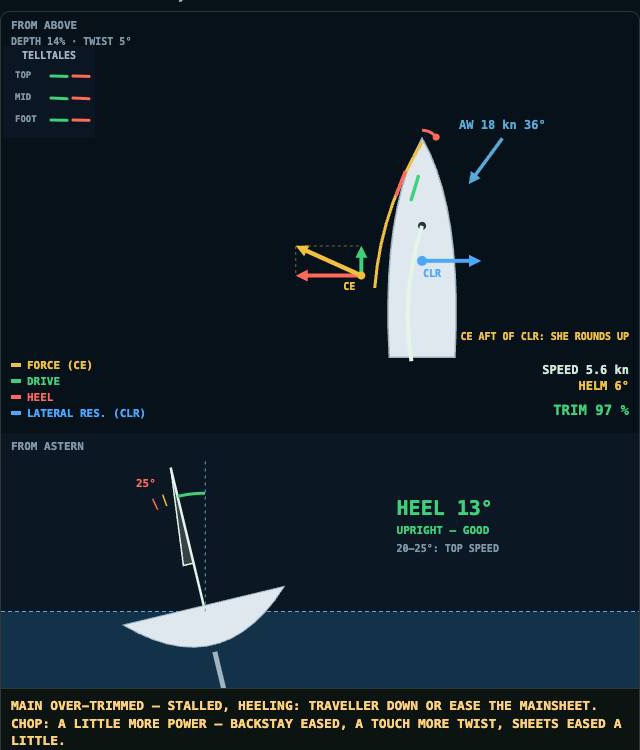
Most sailors trim by feel and never quite know why the boat is slow, heeling or heavy on the helm. This trainer shows it: the boat from above with the apparent wind, each sail at its angle, the force the sails make — what drives her and what heels her — the centre of effort against the keel's lateral resistance, the telltales at three heights, and the boat from astern with her heel. A 3-D view shows the boat itself in the water — the cloth of each sail at its angle, twist and depth, the draft stripes, the telltales, the heel — from astern, from the cockpit, from the side or from above.
With a Marine Simulator Training subscription. Runs on a phone, a tablet or a computer.
Three levels
Every step sets the boat up wrong on purpose and says what to reach — and how the line is worked on deck: the car on its track, the sheet on its winch. When the sails are right and stay right, the step is ticked.
Free practice
- Choose the course to the wind and the wind speed, a flat sea, a chop or waves, steady or gusty wind.
- Mainsheet, traveller, kicker, backstay; the genoa or the jib with its sheet and car; a reef.
- The spinnaker: the pole's angle and height, its sheet — and the broach if you let it happen.
- The heel, the helm, the speed and the trim percentage answer at once, with a word on what to change.
The spinnaker gybe with lazy guys
On a bigger boat each spinnaker clew carries two lines, a sheet and a guy — four in all. Tap the eight steps of the gybe in their order: bear away, load the lazy sheet, trip the guy, dip the pole, clip the lazy guy, square the pole, gybe the main, head up. The drawing moves every line with you: the working ones solid, the lazy ones dashed.
Know what to pull before you are on the water
Questions
Who is the sails trim simulator for?
For anyone who sails or wants to: the beginner who has never known what the traveller is for, and the cruising skipper who wants the boat faster, flatter and lighter on the helm. It comes with a Marine Simulator Training subscription.
What does it teach?
The two controls of every sail — its angle to the wind and its twist — and which line sets which: the main's traveller and mainsheet, the genoa's and the jib's sheet and car on the track. Then the telltales at three heights, depth and the backstay, the heel and the helm, the centre of effort against the centre of lateral resistance, the slot between the sails, waves and gusts, reefing, the spinnaker and its gybe with lazy guys.
How do the levels work?
Each level sets the boat up wrong on purpose — a traveller far down, a genoa stalled, a car too far aft — and tells you what to reach. When the sails are right and stay right, the step is ticked and the next one opens. Level 1 is the main and the genoa; level 2 strong and light wind, the cars and the jib; level 3 both sails together in a chop. Free practice and the spinnaker gybe drill are there any time.
Does it work on a phone?
Yes — it runs in the browser on a phone, a tablet or a computer, nothing to install.
Is it a real boat?
It is a trainer: a cruising yacht of about 30 ft whose numbers follow the rules good sail-trim teaching uses. It cannot give you the feel of a sheet in your hand, but it shows what each line does and why — so on the water you know what to pull.